![VEXCEL_Data_Program_Brand_outline_Logo_Horizontal_Black.jpg]](https://support1.vexceldata.com/hs-fs/hubfs/Logos/VEXCEL_Data_Program_Brand_outline_Logo_Horizontal_Black.jpg?height=40&name=VEXCEL_Data_Program_Brand_outline_Logo_Horizontal_Black.jpg)
Pavement Marking Condition Assessment
Pavement marking roadway features have a quality_score value that scores the marking visibility using subjective criteria. Markings are scored from 1 to 4 based on visibility of defects.
|
Score |
Example |
Description |
|---|---|---|
|
Good: 4 |
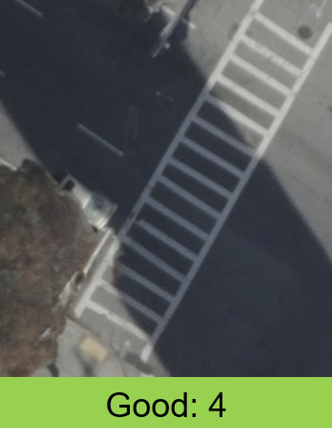 |
Good. No visible signs of defects. |
|
Acceptable: 3 |
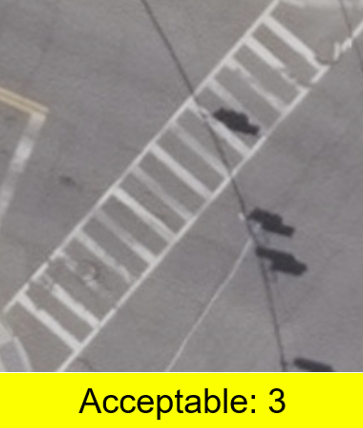 |
Acceptable. Minimal signs of defects. |
|
Fair: 2 |
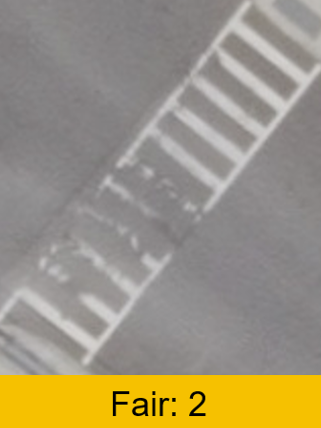 |
Fair. Pronounced signs of defects that affect the function of the marking. |
|
Poor: 1 |
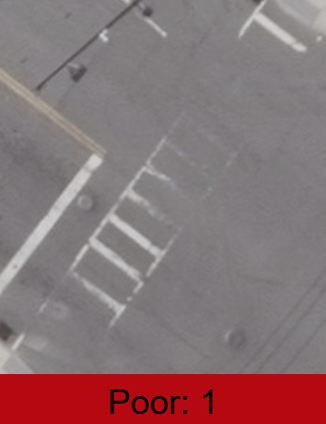 |
Poor. Pronounced signs of defects that significantly affect the function of the marking. |
Using this data, pavement markings can be quickly filtered by category and quality_score to identify markings for further review.
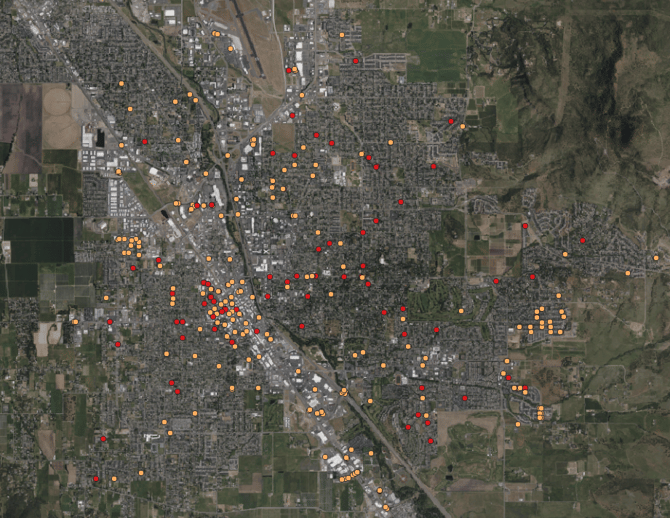
 Crosswalk pavement markings with
 quality_score 1 or 2.Roadway Inventories for Bike and Pedestrian Facilities
- Crosswalks - locations, conditions, and crossing distances of standard and high-visibility crossings at intersections and midblock.
- Bicycle lanes - locations of bicycle-related symbols, words, and green colored pavement to update maps.
- Infrastructure - locations of ADA detectable curb mats (truncated dome) and pedestrian refuge islands.
Roadway Inventories for FWHA Model Inventory of Roadway Elements (MIRE) Reporting
AI-detected roadway features and pavement markings can be used in geospatial queries and processing routines to populate intersection, approach, and road segment GIS features with several attributes useful for Federal Highway Administration (FHWA) Model Inventory of Roadway Elements (MIRE) inventories and reporting. The table below lists MIRE data elements that can be populated using Elements Roadways data.
|
MIRE Data Element |
MIRE No. |
MIRE Data Type |
Data Attributes |
|---|---|---|---|
|
Presence/Absence of Bicycle Facilities |
41 |
Roadway Segment |
Presence/Absence:
|
|
School Zone Indicator |
99 |
Roadway Segment |
Indication of school zone.
|
|
Type of Intersection/Junction |
111 |
At-Grade Intersection/Junctions |
Presence/Absence:
|
|
Intersection/Junction Number of Legs |
115 |
At-Grade Intersection/Junctions |
Numeric |
|
Intersection/Junction Geometry |
116 |
At-Grade Intersection/Junctions |
Presence/Absence:
|
|
Intersection/Junction Traffic Control FDE |
121 |
At-Grade Intersection/Junctions |
|
|
Circular Intersection - Bicycle Facility |
127 |
At-Grade Intersection/Junctions |
Presence of bicycle facility
|
|
Number of Approach Through Lanes |
134 |
At-Grade Intersection/Junctions |
Numeric |
|
Number of Exclusive Left-Turn Lanes |
136 |
Intersection Leg (each approach) |
Numeric |
|
Number of Exclusive Right-Turn Lanes |
140 |
Intersection Leg (each approach) |
Numeric |
|
Approach Traffic Control |
144 |
Intersection Leg (each approach) |
|
|
Crosswalk Presence/Type |
147 |
Intersection Leg (each approach) |
|
|
Circular Intersection - Presence/Type of Exclusive Right-Turn Lane |
160 |
Intersection Leg (each approach) |
|
|
Circular Intersection - Pedestrian Facility |
165 |
Intersection Leg (each approach) |
|
ADA Compliance Assessment
-
Locations of required detectable warnings (truncated domes) on curb ramps per U.S. Department of Justice 2010 ADA Standards for Accessible Design.
-
Locations of accessibility parking spaces using Accessibility Symbol detections.
Confirm and Document Installation of Countermeasures
-
Creation of as-builts for FWHA proven Pedestrian/Bicyclist countermeasures (e.g., high-visibility crosswalks, advance stop and yield lines, and pedestrian refuge islands).